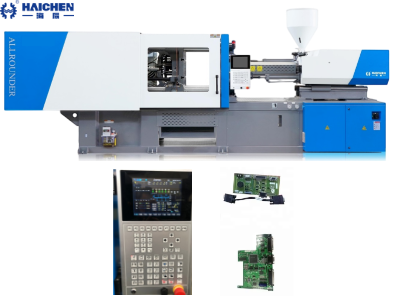
Hold Pressure and Back Pressure are two different concepts in plastic injection molding and other engineering fields. Although they are both related to pressure, their functions and purposes are different.
Back pressure and holding pressure play different roles in the plastic injection molding process, and their reasonable settings are crucial for ensuring product quality and production efficiency. In injection molding and other processes, the back pressure and holding pressure both need to be precisely controlled in stages. The back pressure optimization occurs during the plasticization period, and pressure dominates the later stage of filling to jointly ensure the performance of the final product
To this topic about the difference between back pressure and holding pressure. We will analyse from like basic definition, function, setting and other aspects of back pressure and holding pressue.
- Definition
- Function and purpose
- Control and Settings
- The impact on product quality
- Relationship with other parameters
- Application scenarios
Definition
Hold Pressure
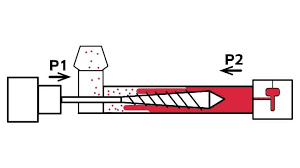
Hold pressure refers to the pressure applied during the plastic injection molding process to prevent resin backflow, compensate for resin shrinkage during cooling, and ensure the quality of mold parts. Its main purpose is to maintain the pressure in the mold cavity to prevent product deformation or shrinkage. If the hold pressure is set too high, it may cause product overfilling, overflow or stress concentration. If it is set too low, it may cause product shrinkage, dimensional instability or deformation. The hold pressure usually sets to about 30% of the injection pressure.
Back Pressure
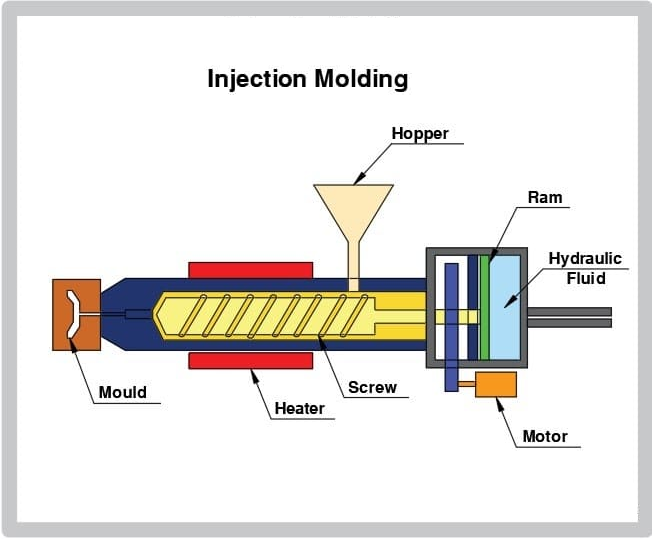
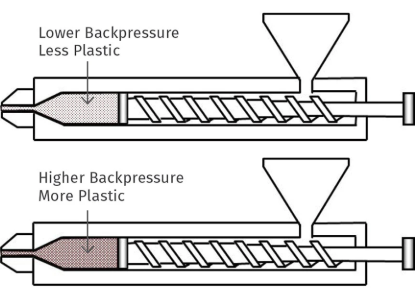
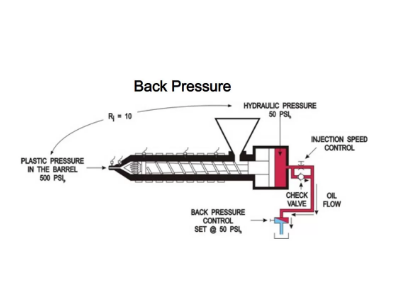
Back pressure refers to the pressure that hinders the natural flow of fluid in a hydraulic system or other fluid system. In plastic injection molding, back pressure mainly uses to help the plastic melt mix evenly. And plasticize evenly when the screw returns. And futhermore to reduce the length of plastic fibers. Too high back pressure will prolong the screw return time, increase the heat input of the injection machine, and may cause the temperature to rise. Therefore, the back pressure usually sets low, not exceeding 20% of the injection pressure.
Function and purpose
The function of back pressure
Promote the uniform mixing of molten plastics and improve the flowability of materials.
Extend the retreat time of the screw to fully plasticize the material in the screw.
Helps eliminate bubbles and impurities, improve product quality.
The function of maintaining pressure
Prevent material shrinkage during the cooling process, thereby avoiding product deformation or dimensional deviation.
Maintain pressure in the mold to prevent the melt from flowing back from the mold (resin reflux).
Helps eliminate weld lines and surface defects.
back pressure injection molding
Control and Settings
Control of back pressure
Maintain pressure control
The impact on product quality
The impact of back pressure
Excessive back pressure may lead to material degradation and affect the mechanical properties of the product.
The impact of maintaining pressure
Excessive holding pressure may lead to product overflow or stress concentration, while excessively low holding pressure may result in unstable product dimensions.
Relationship with other parameters
The relationship between back pressure and injection pressure
Maintain the relationship between pressure and injection pressure
Application scenarios
Maintaining pressure is widely used in plastic injection molding to control the pressure distribution in the mold.
Back pressure more commonly uses in hydraulic systems or in situations. There melt fluidity need to improve. Such as the screw return stage in plastic injection molding.
Although both holding pressure and back pressure involve pressure, their mechanisms of action, purposes, and setting ranges are completely different. Holding pressure is mainly used to maintain pressure in the mold cavity, while back pressure is used to improve the fluidity and plasticization effect of the melt.