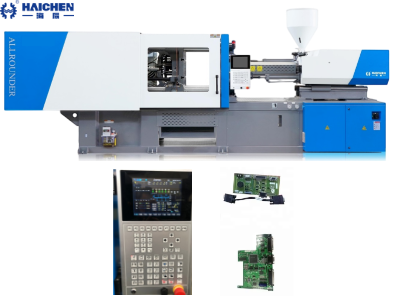
The main disadvantage of a servo motor for injection molding machines:
- Comprehensive cost
- System complexity
- Compatibility and upgrade obstacles
Although servo motors perform well in terms of precision and response speed, they may not be the best choice in some application scenarios.
When choosing a servo motor, its advantages and disadvantages should be comprehensively considered based on specific requirements.
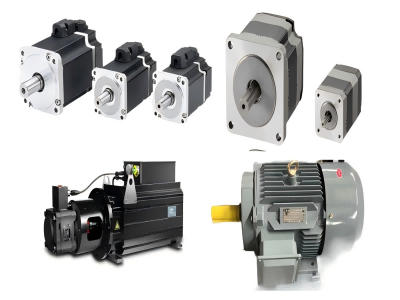
What is a Servo Motor for injection molding machine?
Servo motors allow precise control of angular position, acceleration, and velocity.
A closed-loop control system is employed with this type of motor.
A closed-loop control system considers the current output and modifies it to achieve the desired condition.
In these systems, the control action is based on the motor output.
A positive feedback system controls the motion and final position of the shaft.
Servo motors provide versatility in the manufacturing environment.
It also requires a relatively sophisticated controller.
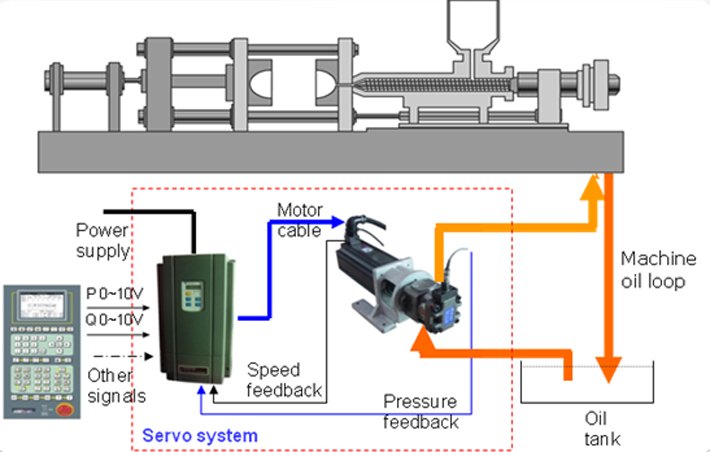
The main disadvantage of a servo motor——Comprehensive cost
- Rising raw material prices
- High manufacturing cost
- High cost of the encoder and its accessories
Servo motors and their accompanying controllers and encoders are often costly.
Especially for high-performance models, which makes their initial investment relatively large.
Rising raw material prices
The main plastic raw materials for servo motors include magnets, copper, silicon steel, aluminum, etc.
And the prices of these materials have generally increased in recent years.
High manufacturing cost
The manufacturing cost of servo motors is high, and labor costs and manufacturing expenses mainly reflect this.
The production capacity of servo motors and the level of automation of production lines are still in the stage of improvement, resulting in relatively high manufacturing costs.
High cost of the encoder and its accessories
One of the core components of servo motors is the encoder, which accounts for a relatively high proportion of the cost.
The main components of the servo motor include encoders, motor spindles, and other hardware.
While the encoder and its accessories, as the core components of the servo motor, account for a relatively high proportion of material costs.
The main disadvantage of a servo motor——system complexity
- High requirements for power quality
- Difficult debugging
- Poor performance at low speeds
- Heating problem
- Vibration and noise
- Environmental sensitivity
- Mechanical complexity
- Debugging and protection circuit requirements
High requirements for power quality
Servo motors have high requirements for power supply quality.
And power fluctuations may lead to a decrease in the accuracy and stability of their motion control.
Difficult debugging
The debugging of servo motors requires a high technical level of engineers.
Involving fine adjustment of controllers, encoders, sensors, and other components, and the debugging cycle is long.
Poor performance at low speeds
Servo motors have poor performance at low speeds, and torque and speed will decrease.
So gear reduction or other ways of deceleration are required at low speeds.
Heating problem
The servo motor will generate a certain amount of heat when it is running.
And if the heat dissipation is poor, it may cause the motor to overheat, affecting its performance and life.
Vibration and noise
They may generate vibration and noise when operating at low speeds.
Which may affect their use in some applications.
Environmental sensitivity
Servo motors are sensitive to the working environment, and factors such as temperature, humidity.
And dust may affect their normal operation, especially in high-temperature, high-humidity, or dusty environments.
Mechanical complexity
The servo system combines a brushed DC motor, a potentiometer, a complex set of gears, and a controller PCB.
And this complexity means that there are more potential points of failure than other motor types.
Debugging and protection circuit requirements
To keep the feedback loop running stably, the servo motor needs to be adjusted regularly.
And the protection circuit is needed to buffer sudden failures to avoid inconvenience in use.
The main disadvantage of a servo motor——Compatibility and upgrade obstacles
- The system integration is difficult
- Technological iteration risk
- Performance limitations
- Limited overload capacity
The system integration is difficult
When the old injection molding machine is retrofitted, the servo motor needs to be matched with the mechanical structure.
Such as lead screw lead, and the retrofit cost can reach 40% of the cost of the new machine.
Technological iteration risk
Servo technology updates rapidly, and the risk of old model spare parts being discontinued is high.
Enterprises need to stockpile high-priced spare parts (such as dedicated encoders).
Performance limitations
When the clamping force exceeds 1,000 tons, the hydraulic system has more advantages in terms of cost and power stability.
And the servo motor is difficult to provide continuous high pressure.
Limited overload capacity
The short-term overload capacity of a servo motor is typically 150% to 200%.
Which is lower than that of a hydraulic system (up to 300%), and it is prone to trigger a protective shutdown under sudden load changes.
How does make up for the disadvantage of servo motor?
- Energy-saving transformation
- Adopt low moment of inertia technology
- Adopt oil-electric servo energy-saving system
Energy-saving transformation
Through servo transformation of injection molding machines.
Improve the utilization rate of raw materials and energy, reduce the generation of defective products, and reduce energy consumption.
Adopt low moment of inertia technology
Through the special design of the magnetic circuit and weight reduction structure of the servo motor rotor, reduce the rotor inertia of the servo motor.
So that it can respond quickly to the input signal in a shorter time, to improve the response speed of the motor.
Reduce the heat generation, improve the service life, and then improve the production efficiency of the injection molding machine.
Adopt oil-electric servo energy-saving system
Combined with AC permanent magnet synchronous servo motor and injection molding machine oil-electric servo energy-saving system.
To achieve high efficiency and energy-saving benefits.